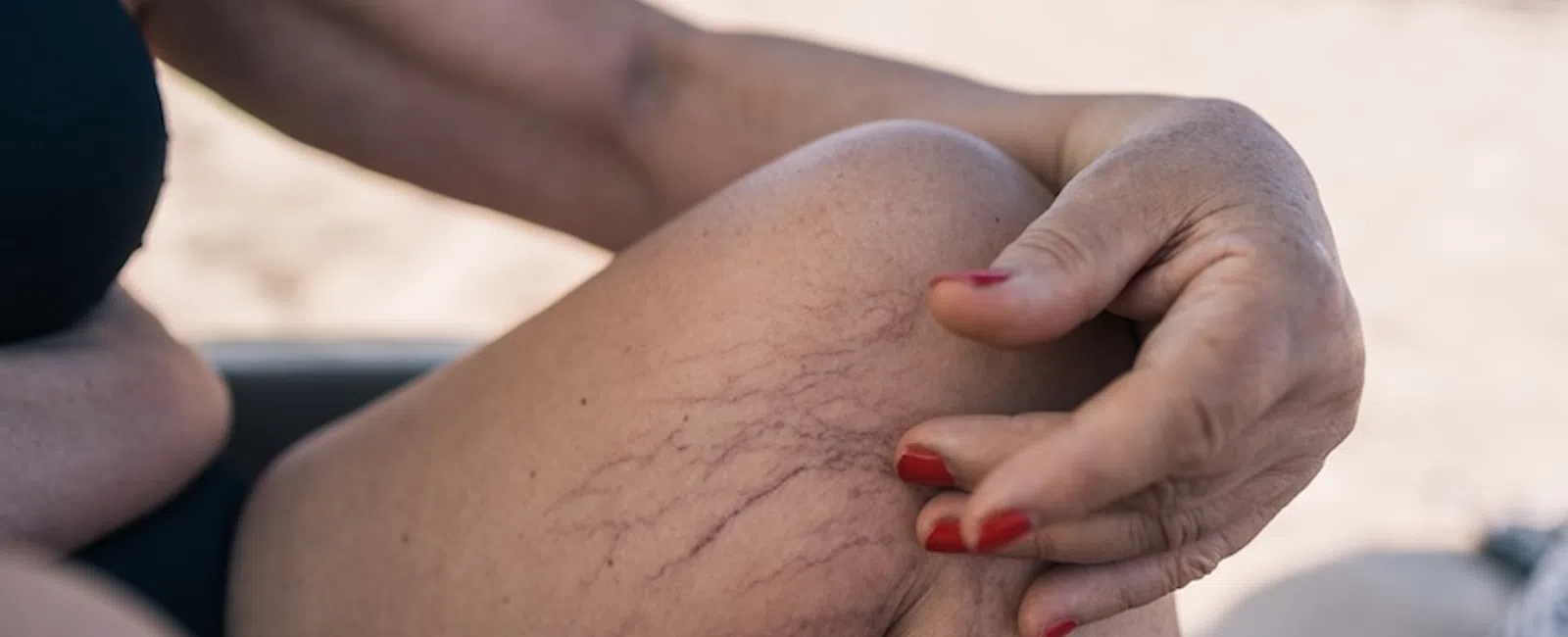
You've probably noticed them before — maybe while putting on sunscreen before a weekend at the lake, or catching your legs in the bathroom mirror the first hot morning you pull on shorts. A faint web of red or purple lines along your calf. Or maybe it's more than lines. Maybe there's a ropy, raised cord of blue along the inside of your leg that you've been mentally filing under "deal with that later" for about three summers now.
Here's what most patients don't realize: spider veins and varicose veins are not just two names for the same thing. They look different, they feel different, and — most importantly — they mean different things about what's actually happening inside your legs. One is almost always a cosmetic nuisance. The other is a circulatory issue that can get worse year by year if nothing changes.
Spider veins are small, surface-level vessels that appear red, blue, or purple and are usually harmless. Varicose veins are larger, twisted, and bulging veins that develop when the valves inside the vein stop working properly, allowing blood to pool. While spider veins are often cosmetic, varicose veins are a circulatory issue — one that tends to progress, not stabilize, when left untreated.
What Are Spider Veins?
Spider veins — the clinical term is telangiectasias — are the thin, thread-like lines that branch out in web or starburst patterns, usually on the legs or face. They sit just under the surface of the skin and are typically red, purple, or blue. They don't bulge. They usually don't hurt.
They're more common than most people think. According to the U.S. Office on Women's Health, spider veins may affect more than half of all women. That's not an outlier statistic — it means the patient embarrassed about her legs in the exam room is in the majority, not the exception.
The cause is essentially the same as varicose veins at a mechanical level: tiny valves in small blood vessel walls weaken or fail, and blood collects in the vessel instead of flowing back toward the heart. But because spider veins sit in smaller, shallower capillaries, the pressure doesn't build the way it does in larger veins, which is why the symptoms stay mild or absent.
Do Spider Veins Need Treatment?
Most don't — not medically. They're not a sign of anything dangerous on their own. But if they bother you cosmetically, treatment is available and very effective. Asclera sclerotherapy involves a simple injection that causes the vein to close and fade over a few weeks. Beltline Health's spider vein removal program is one of the most common outpatient procedures we do — quick, low downtime, and done in the office.
The caveat: if you're seeing a significant number of new spider veins appearing quickly, or if they come alongside aching, heaviness, or leg swelling, don't file that away. It's occasionally a surface signal that something larger is happening deeper in the leg.
What Are Varicose Veins?
Varicose veins are bigger. They bulge. You can see and feel them — a cord of dark blue or purple sitting under and often above the skin of the thigh, calf, or ankle. They look different from spider veins because they are different. These are larger veins where the one-way valves have failed in a meaningful, structural way.
Here's how it works in plain language: your leg veins fight gravity with every heartbeat to push blood back up toward your heart. They use a series of tiny valves that open and close in sequence to prevent backflow. When a valve weakens — from genetics, pregnancy, a job that keeps you on your feet all day, or just time — blood starts pooling below that valve. The vein stretches to hold it. It twists. It presses against the skin. That's what a varicose vein looks like from the outside.
Research published in PubMed Central estimates varicose veins affect nearly 30% of the world's population. They're not rare. They're not just something that happens to other people.
Why Varicose Veins Matter Beyond Appearance
This is the part patients often miss. Left untreated, varicose veins don't plateau — they tend to progress. The blood pooling in those veins creates sustained pressure on the vessel wall and the surrounding tissue. Over time, that leads to:
- Leg heaviness, aching, and fatigue that worsens as the day goes on
- Swelling in the ankles and feet, especially during Georgia summers
- Skin changes around the ankle — discoloration, dryness, or a leathery texture
- A condition called chronic venous insufficiency (CVI), where the pooling becomes a chronic circulatory problem
- In the most advanced stages: venous ulcers — open wounds near the ankle that are slow and difficult to heal
The ache you feel after being on your feet all day at work? The swelling that makes your shoes feel tight by early afternoon? That's not just aging. It's often the veins — and it's worth knowing the difference.
Spider Veins vs. Varicose Veins — Side by Side
| Spider Veins | Varicose Veins | |
|---|---|---|
| Appearance | Thin, web-like lines; red, blue, or purple | Large, twisted, bulging cords; blue or dark purple |
| Location | Surface of the skin | Beneath and often raised above the skin |
| Size | Very small (under 1mm) | 3mm or larger |
| Common areas | Legs, face, chest | Thighs, calves, ankles |
| Typical symptoms | Usually none | Aching, heaviness, swelling, itching |
| Root cause | Weakened capillary walls | Failed one-way vein valves |
| Medical concern? | Rarely — typically cosmetic | Often yes — can progress without treatment |
| Treatment options | Sclerotherapy (Asclera) | Sclerotherapy, RFA, VenaSeal, ablation |
| Insurance coverage | Usually not covered | Often covered when symptomatic |
When Should You Actually Do Something?
Here's the honest answer: if your varicose veins are causing symptoms — aching, swelling, heaviness, cramping, skin changes, or restless legs at night — you should come in for an evaluation. Not because we'll immediately start a procedure, but because we need to understand what's actually going on. A quick duplex ultrasound tells us whether your vein valves are functioning properly or not, and that changes everything about what we recommend.
If your spider veins are purely cosmetic and not bothering you, the decision is yours. No pressure, no urgency.
The patients we're more concerned about are the ones in the middle — people with varicose veins that don't hurt yet, who are waiting until they do. By the time varicose veins become consistently painful, the underlying valve damage has typically been progressing for years. Most vein patients wait years before coming in — and that delay almost always makes treatment more involved than it needed to be.
If you're on the fence, an evaluation costs nothing except an hour of your time. You'll leave with a clear picture either way.
What Does Vein Treatment Actually Look Like Today?
The short version: it's not what it used to be. Vein stripping — the surgical procedure that gave vein treatment a bad reputation for recovery time and discomfort — is largely a thing of the past.
According to Harvard Health, varicose vein treatment has evolved significantly, from hospital-based surgery to minimally invasive, office-based techniques that most patients walk out of the same day.
At the Vein Center at Beltline Health, we use three main approaches depending on the vein:
- Radiofrequency Ablation (RFA): A small catheter delivers controlled heat inside the problem vein to seal it shut. The body reroutes blood through healthy nearby veins. Most patients are back to light activity within a day.
- VenaSeal: A medical-grade adhesive that closes the vein — no heat, no tumescent anesthesia required. Good option for patients who want minimal procedural discomfort.
- Sclerotherapy (Asclera): An injectable solution that collapses smaller varicose veins and spider veins from the inside out. Multiple sessions may be needed depending on the extent of the veins.
The right approach depends entirely on the size, location, and severity of what we find — which is exactly what we assess at your first visit.
One more practical note: when varicose veins cause documented symptoms, treatment is frequently covered by insurance. Spider vein treatment for cosmetic reasons typically is not. Learn more about what insurance covers for vein treatment before your visit so there are no surprises.
Not Sure Which Type You Have? Start Here.
The first step isn't a procedure — it's a conversation. Our vein specialists at Beltline Health will look at your legs, run a duplex ultrasound if needed, and give you a straight answer about what's happening and what your options are. No guessing. No pressure.
Schedule your vein consultation at Beltline Health →
Frequently Asked Questions
Are spider veins dangerous?
Spider veins are almost always a cosmetic concern, not a medical emergency. On their own, they don't typically signal serious underlying disease. That said, if you're developing a large number of new spider veins quickly, or if they come with leg heaviness, swelling, or aching, it's worth having a vein specialist evaluate you — those symptoms can sometimes point to deeper venous insufficiency that's worth addressing.
Can varicose veins go away on their own without treatment?
No. Once a vein valve fails and the vein enlarges, it won't repair itself. Compression stockings, regular walking, and elevating your legs can ease symptoms and slow progression, but they don't fix valve damage. The only way to eliminate a varicose vein is through a procedure — sclerotherapy, ablation, or adhesive closure — that permanently closes or removes it.
When should I see a doctor about varicose veins?
If your varicose veins are causing aching, heaviness, swelling, cramping, skin changes, or restless legs, those are clear signals for an evaluation. Even if you're currently symptom-free, a vein specialist can tell you whether your veins are stable or trending toward a more serious stage. Earlier evaluation almost always means simpler treatment.
Does insurance cover varicose vein or spider vein treatment?
Insurance typically covers varicose vein treatment when there are medically documented symptoms like pain, swelling, or skin changes. Spider vein treatment is usually classified as cosmetic and not covered. The distinction matters — Beltline Health's team can help you understand your coverage before you book an appointment.
Medically Reviewed By: Charles Procter, Jr., MD, FACS